EUGÈNE CARRIÈRE PAINTINGS FOR SALE & BIOGRAPHY
EUGÈNE CARRIÈRE
French, 1849 - 1906
BIOGRAPHY
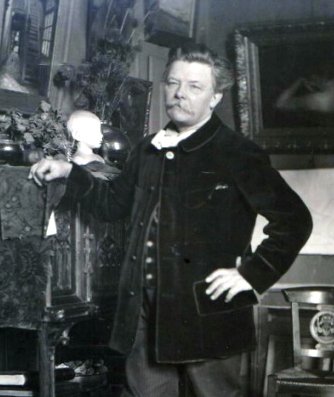
Eugène Carrière was born in Gournay-sur-Marne, east of Paris. He was the eighth child of Elisabeth-Margaret Wetzel and Léon Carrière. Although his father was an insurance salesman, there were several artists in his family, including his uncle who was a painter of portraits and genre subjects, and his grandfather who was a professor of drawing. At the age of twelve, Carrière began his artistic studies at the École Municipale de Dessin in Strasbourg and by fifteen was apprenticed to a lithographer.
Carrière visited the Louvre in Paris in 1868 and was profoundly influenced by the works of Peter Paul Rubens, in addition to those of Turner, Rembrandt and Frans Hals. He returned to Paris in 1869 to study under Alexandre Cabanel at the École des Beaux-Arts. The Franco-Prussian War of 1870-71 interrupted his studies, which he would not complete until 1876. “Carrière failed to secure a Prix de Rome in 1876, but made a successful debut at that year’s Paris Salon and went on to make his mark in 1879 with Young Mother. After that his work attracted the attention of art critics as disparate as Roger Marx, Gustave Geoffroy, Jean Dolent, Charles Morice and Albert Aurier, who all acknowledged this up-and-coming 'painter of motherhood'. Carrière was soon moving in artistic and literary circles that included Edmond de Goncourt, Alphonse Daudet, Paul Verlaine (whose portrait he later painted), Gabriel Séailles (Carrière's subsequent biographer), the Chausson family, Paul Gauguin, Puvis de Chavannes, Auguste Rodin and others… By 1889, Carrière had secured 'official' recognition as an artist. Major public commissions came his way, starting with decorations for the Hôtel de Ville in Paris (1889) and continuing with similar commissions for the Sorbonne (1898) and the 12th Arrondissement town hall (1897). In the 1890s, when arguably at his most prolific as a lithographer, he joined forces with Rodin, Puvis de Chavannes and Bracquemont to found the Société Nationale des Beaux-Arts. He also launched a 'free' academy between 1898 and 1903 that numbered among its pupils the future Fauvists Henri Matisse and André Derain and which paved the way for the Salon d'Automne, an institution fostered by Carrière and which appointed him as its first president.
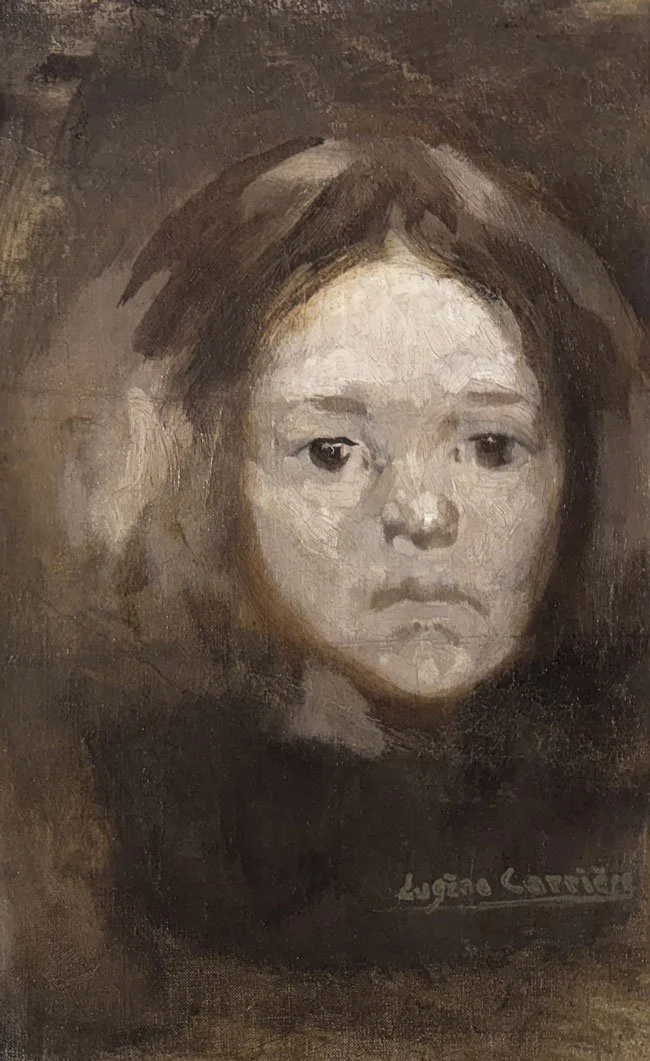
"Eugene Carrière evolved from an early intimate realism into the dynamic and vibrant monochrome style of his mature years. He shared the concerns of the Symbolists but opted to develop a pictorial language that eschewed decadent elitism and the purely decorative lines of Art Nouveau. In terms of technique, Carrière worked with a sure and fluid touch, using shades of brown and red to render expressive detail. Carrière had his detractors, among them Edgar Degas, but there were others - including Auguste Rodin (see Carrière's 1900 lithograph of Rodin at Work) and the 'genre' sculptor Medardo Rosso - who shared his aesthetic and were his loyal apologists. At times, Carrière's bold technique verges on abstraction in the sense that his preoccupation is with the archetype rather than with the individual. His entire body of work - oils, charcoal, lithographs - is characterized by this commitment to exploring underlying unity and universality rather than superficial diversity.
"Carrière exhibited his work on a regular basis at the Salon de la Société des Artistes Français and subsequently at the Salon de la Société Nationale des Beaux-Arts. He also participated in the Libre Esthétique exhibition in Brussels and in Secession exhibitions in Vienna, Munich and Dresden. His work featured at the Exposition Universelle on several occasions and at the Salon d'Automne. He exhibited solo from 1891. In 1904 a banquet in his honor was organized by Elie Faure and presided over by Rodin.” [Benezit, Dictionary of Artists, Paris, 2006, vol. 3, pp. 480-1]
Robert Rosenblum wrote of Carrière’s late work: “Extinguishing the light of the sun and colors and forms it could illuminate, Carrière retreated into ever more somber and monochromatic mysteries. One might interpret them as the product of a personal and often anguished temperament, were it not for the fact that they are also completely at one with the mood and the look of so much better-known art from the turn of the century. Indeed, they even cast a dark and world-weary glimmer upon the work of a very young artist who, in the years just before Carrière’s death in 1906, also sought spirit rather than substance within a melancholy and pervasive monochrome palette: Pablo Picasso.” [Robert James Bantens, with an introduction by Robert Rosenblum, Eugène Carrière: The Symbol of Creation, New York, 1990, p. 15]
Museum Collections
Akron Art Museum, Akron, OH
Allentown Art Museum, Allentown, PA
Art Gallery of Ontario, Toronto, Ontario
Art Institute of Chicago, Chicago, IL
Cleveland Museum of Art, Cleveland, OH
Denver Art Museum, Denver, CO
Detroit Institute of Arts, Detroit, MI
Fitzwilliam Museum, Cambridge
Frick Collection, New York
Harvard University Art Museums, Cambridge, MA
High Museum of Art, Atlanta, GA
Los Angeles County Museum of Art, Los Angeles, CA
Metropolitan Museum of Art, New York, NY
M.H. de Young Memorial Museum, San Francisco, CA
Minneapolis Museum of Arts, Minneapolis, MN
Musée Calvet, Avignon
Musée d’Art Moderne de Strasbourg, Strasbourg
Musée de Pontoise et du Vexin, Pontoise
Musée des Avalines, St.-Cloud
Musée des Beaux-Arts, Dijon
Musée des Beaux-Arts, Lyons
Musée des Beaux-Arts, Nantes
Musée des Beaux-Arts, Pau
Musée des Beaux-Arts, Toulouse
Musée d’Orsay, Paris
Musée du Louvre, Paris
Musée du Petit Palais, Paris
Musée Lambinet, Versailles
Musée Marmottan-Monet, Paris
Musée Rodin, Paris
Musée Saint-Denis, Reims
Museo Nacional de Bellas Artes, Buenos Aires
Museum of Fine Arts, Boston
Museum of Fine Arts, Ghent
Museum of Modern Art, New York, NY
National Gallery of Art, Washington, DC
National Gallery of Canada, Ottawa, Ontario
National Museum of Wales, Cardiff
Philadelphia Art Museum, Philadelphia, PA
Rhode Island School of Design, Providence, RI
Staatliche Kunstsammlungen Dresden, Dresden
Tate Britain, London
Wadsworth Atheneum, Hartford, CT
Yale University Art Gallery, New Haven, CT
Quisque iaculis facilisis lacinia. Mauris euismod pellentesque tellus sit amet mollis.