
ANTONIO MANCINI PAINTINGS FOR SALE & BIOGRAPHY
ANTONIO MANCINI
Italian, 1852 - 1930
BIOGRAPHY
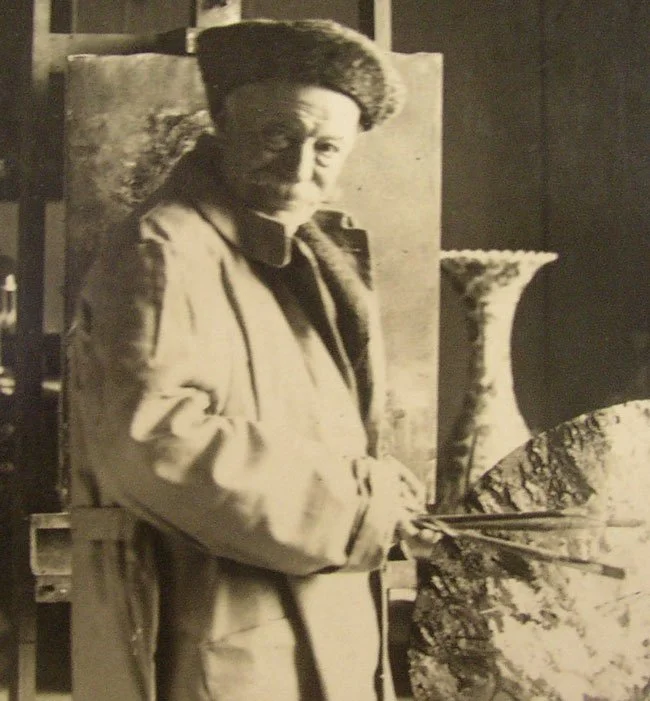
Antonio Mancini was born in Albano Laziale, near Lazio, in November 1852. His studies began early, at the age of twelve, with Stanislao Lista, president of the Accademia di Belle Arti in Naples. His other teachers there were Domenico Morelli and Filippo Palizzi. Morelli recommended the young Mancini to the painter Mariano Fortuny, who proved to be very influential. Early success came in 1871, when two of his works exhibited in the Neapolitan salon were acquired by prominent foreign collectors. In 1873, the dealer Goupil persuaded him to come to Paris, where he met Degas and Manet. The Dutch artist Hendrik Wilhelm Mesdag became an important supporter of Mancini and acquired numerous paintings from him, all now in the collection of De Mesdag Collectie, The Hague.
"Mancini traveled back through Paris and also spent some time in London, where John Singer Sargent introduced him to London society. In 1879, he went back to Naples where... his talent was recognized (particularly by painters of the Naples School such as Michele Cammarano, Giuseppe de Nittis, Eduardo Dalbono and Francesco Michetti) and he lived with the sculptor Vincenzo Germito... In 1883, he finally settled in Rome, his success being permanently established.
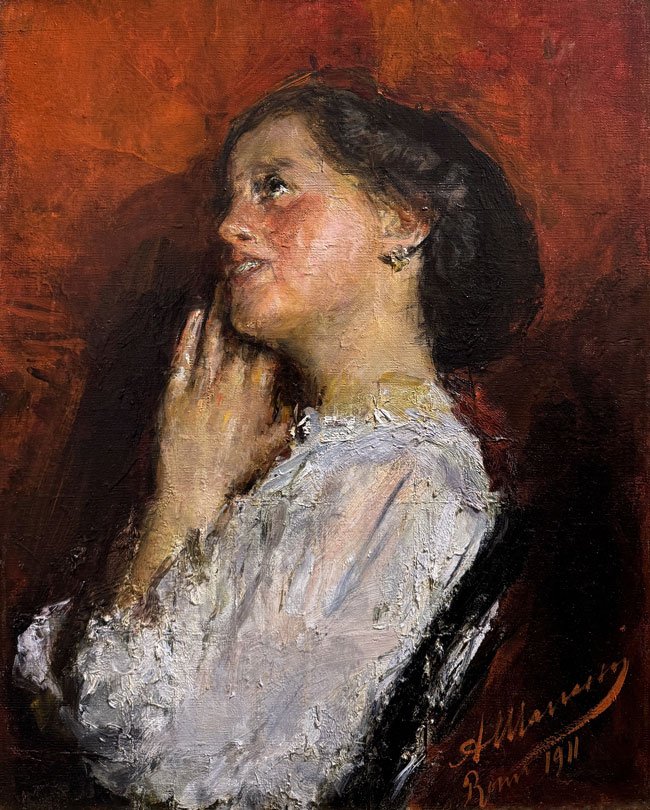
"Apart from his many genre scenes inspired by the picturesque quality of Naples, often portraying poor or sick children, such as The Poor Schoolboy [Musée d’Orsay, Paris], and The Sick Girl, and his unusual nudes and landscapes, he was primarily a portraitist, very often in charcoal, pastel or red chalk. Following the Neapolitan tradition that had endured since the death of Caravaggio, his painting gave priority to the picturesque quality of its subjects - musicians, entertainers, beggars - and accentuated the contrasts of light and shade... Both these characteristics contributed to the character of an alert, spontaneous style of painting with delicate coloring. In the last period of his life, in Rome, his technique became more gestural, almost manneristic, particularly since after 1900 he used a markedly more colorful palette applied in vigorous impasto” [Benezit, Dictionary of Artists, Paris, 2006, vol. 9, p. 135].
Museum Collections
Art Institute of Chicago, Chicago, IL
Atkinson Art Gallery, Southport
Barber Institute of Fine Arts, Birmingham
Buffalo AKG Art Museum, Buffalo, NY
Carnegie Museum of Art, Pittsburgh
De Mesdag Collectie, The Hague
Detroit Institute of Art, Detroit, MI
Galleria d’Arte Moderna Ricci Oddi, Piacenzaantonio
Galleria Nazionale d’Arte Moderna, Rome
Glasgow Museums Resource Centre, Glasgow
Harvard Univeristy Art Museums, Cambridge, MA
Hugh Lane Gallery, London
Isabella Stewart Gardner Museum, Boston, MA
Leeds Art Gallery, Leeds
Lotherton Hall, Leeds
Milwaukee Art Museum, Milwaukee, WI
Minneapolis Institute of Art, Minneapolis, MN
Musée d’Orsay, Paris
Museo Civico-Galleria d’Arte Moderna, Turin
Museo dell’Ottocento, Pescara
Museo Nacional de Bellas Artes, Buenos Aires
Museo Nazionale di San Martino, Naples
National Gallery, London
National Gallery of Art, Washington, DC
National Gallery of Victoria, Melbourne
National Museum, Cardiff, Wales
Philadelphia Art Museum, Philadelphia, PA
Pinacoteca Metropolitana, Bari
Prado, Madrid
Rijksmuseum, Amsterdam
Sheffield Museums, Sheffield
Tate Britain, London
Van Gogh Museum, Amsterdam
Quisque iaculis facilisis lacinia. Mauris euismod pellentesque tellus sit amet mollis.